$249 lifetime
Big trade indicator for NinjaTrader 8
In short: DC Big Trade marks large executions on your chart at the price where most of their contracts traded, with the contract count inside the shape and the aggressor in the colour. It detects two different events — blocks and sweeps — because size shows up in two different ways, and a filter that only looks for one of them misses a third to a half of what matters.
 8
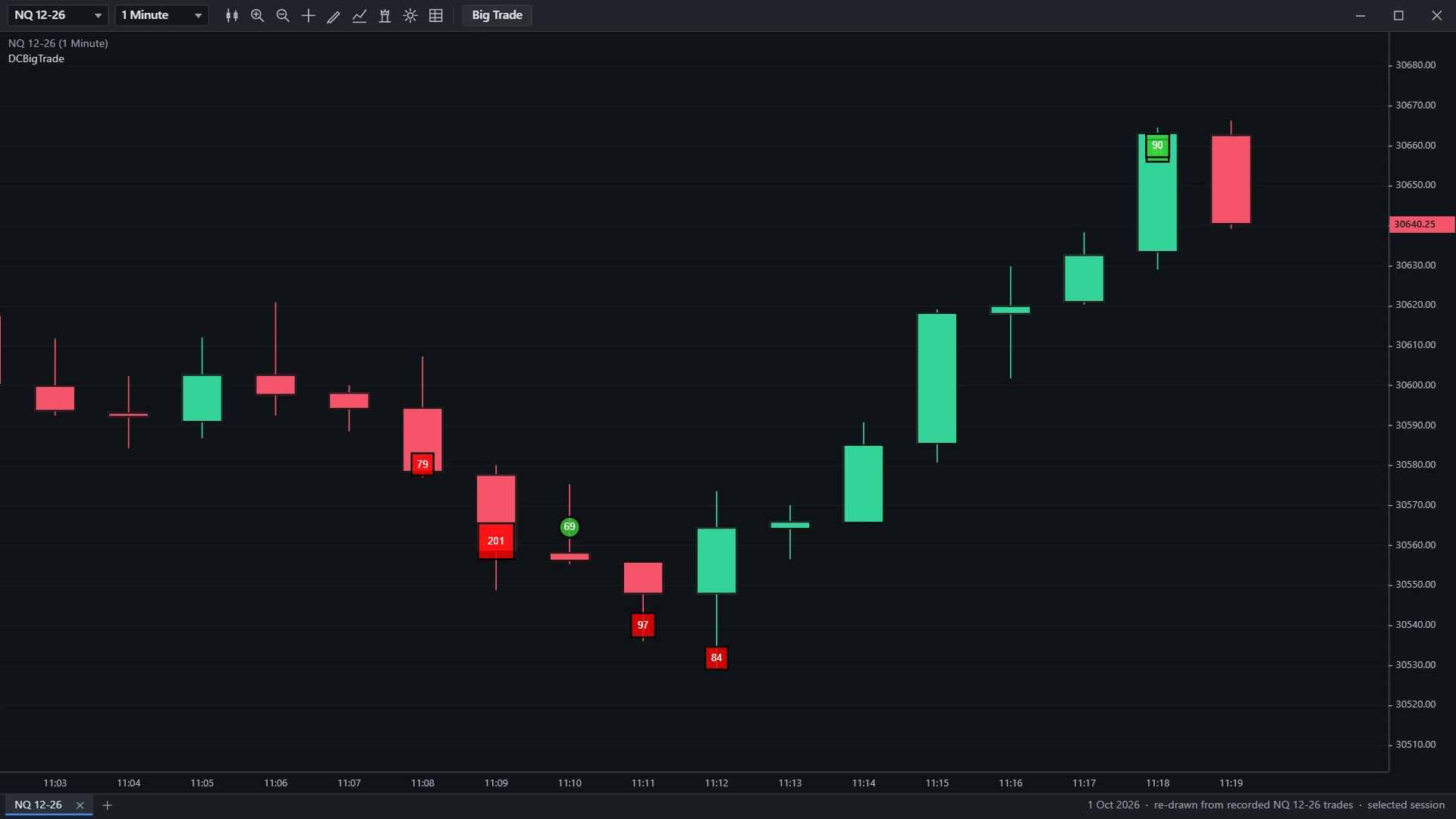
- Sell sweeps into the low From 11:07 four sell sweeps stepped down: 79, 201, 97 and 84 contracts, each across 9 to 36 prices within 50 ms. The last, 84 contracts at 30531.75, printed in the 11:12 bar, whose low of 30529.25 is the lowest trade on this chart.
- A buy sweep in the high bar At 11:28:18, 95 contracts were bought at the ask across 19 prices, drawn at 30680.00 in the bar that made the 11:29 high of 30680.50. Price had traded up to it from the 11:12 low of 30529.25.
- What price did next By 11:45 price had traded back down to 30544.25 from the 30680.50 high.
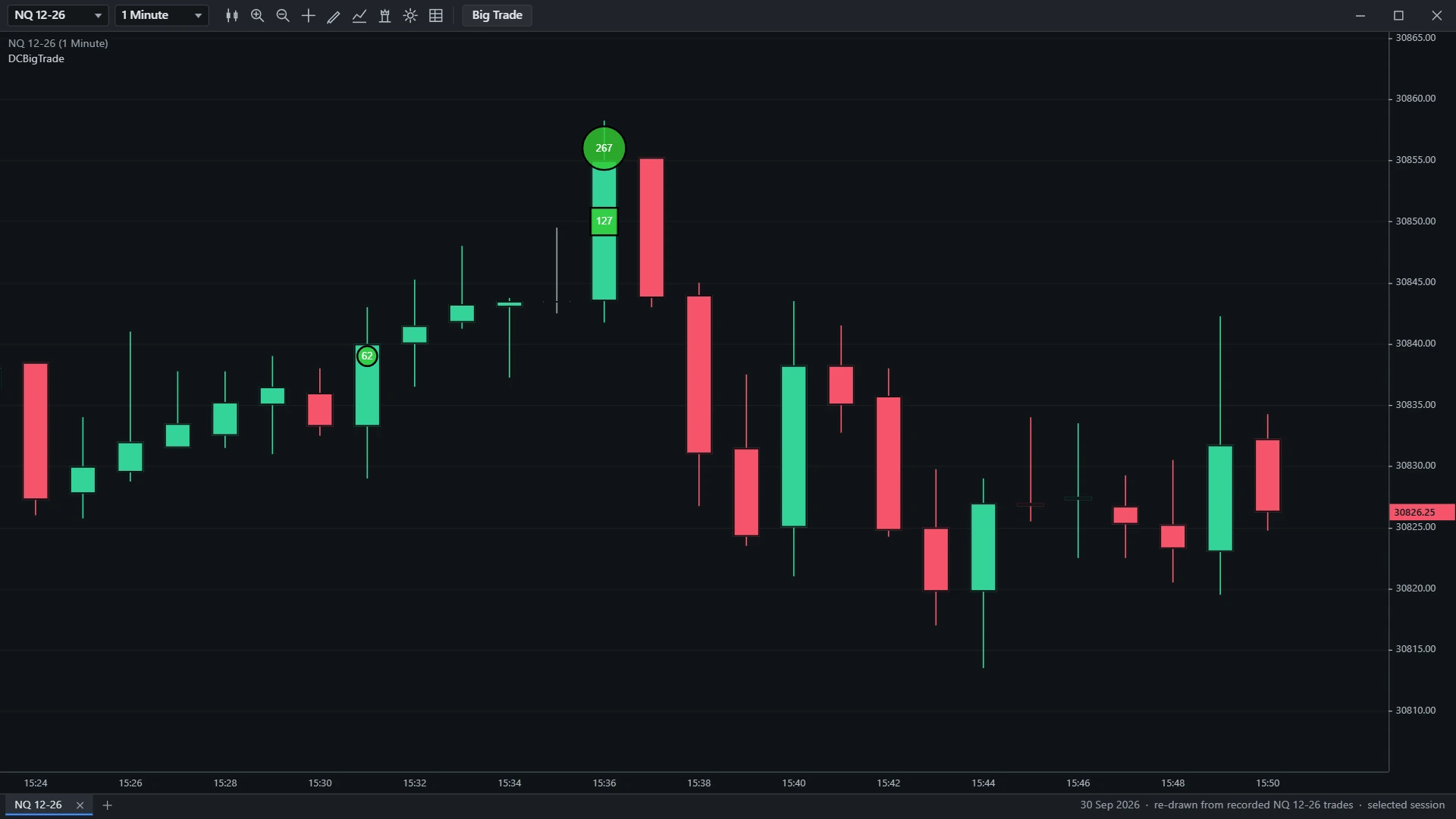
- Square: a sweep A square marks a burst of 75 contracts or more across at least 5 prices, drawn at the price that took the most. This one: 238 sold at the bid across 63 prices, the largest single print 2.
- Circle: a block A circle marks a burst that contains one print of 30 or more: here 159 contracts bought at the ask, 73 of them in a single print. Green is bought at the ask, red sold at the bid, and the number is the total.
On recorded sessions
DC Big Trade on recorded NQ sessions
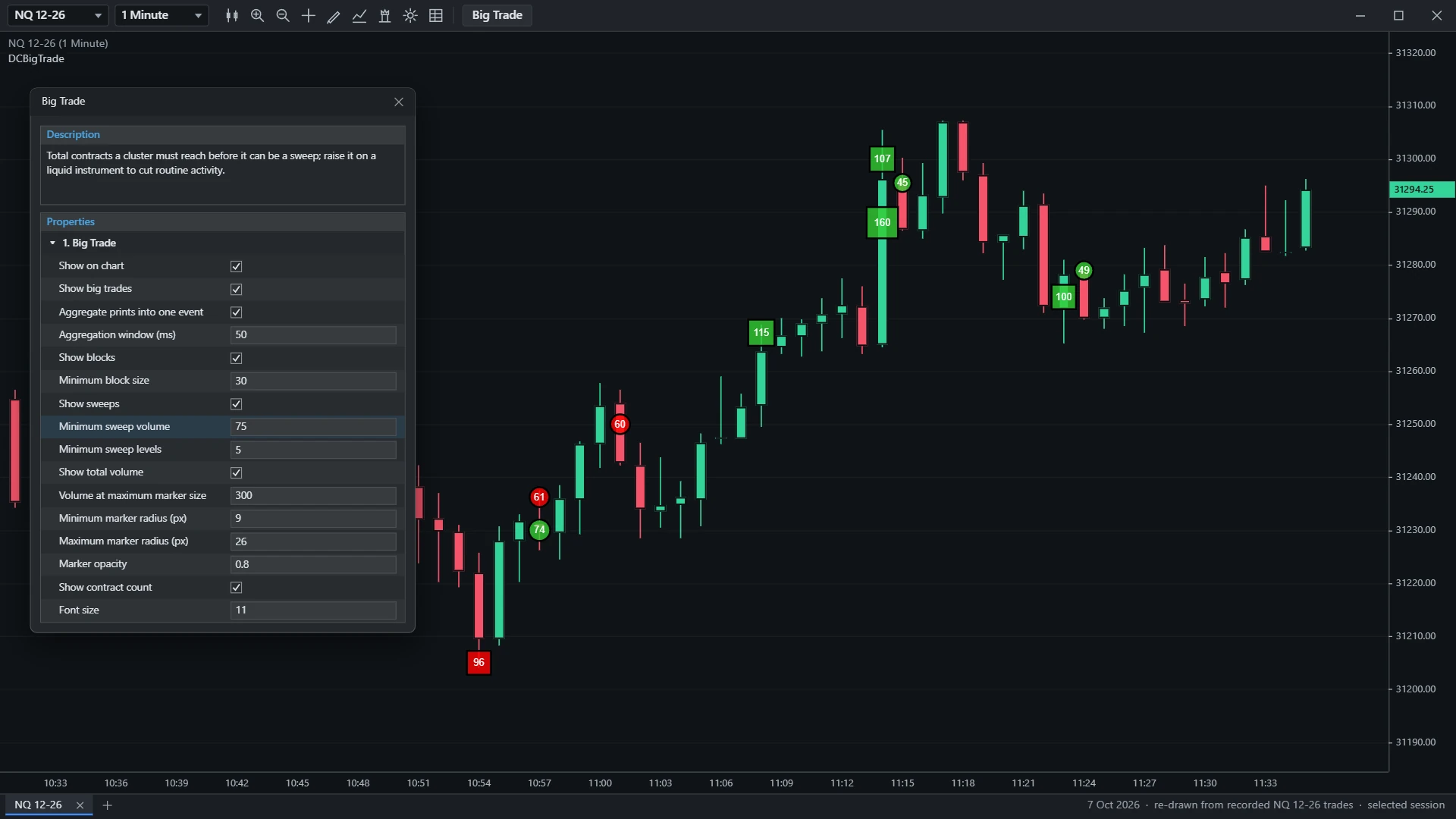
Moments from recorded NQ 12-26 trades, drawn by DC Big Trade's own rules in a NinjaTrader 8 chart window. Click a picture to see it full size.
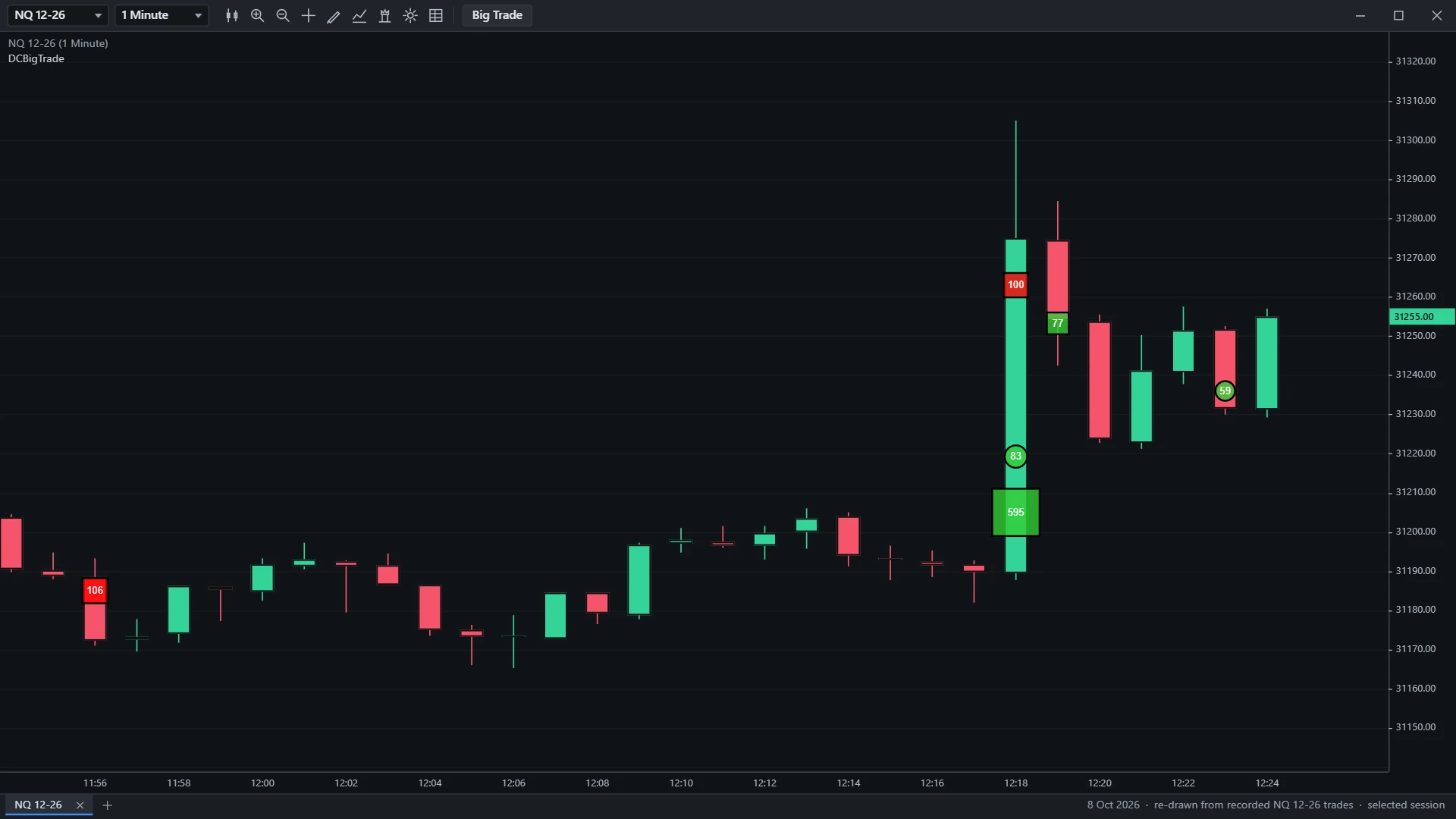
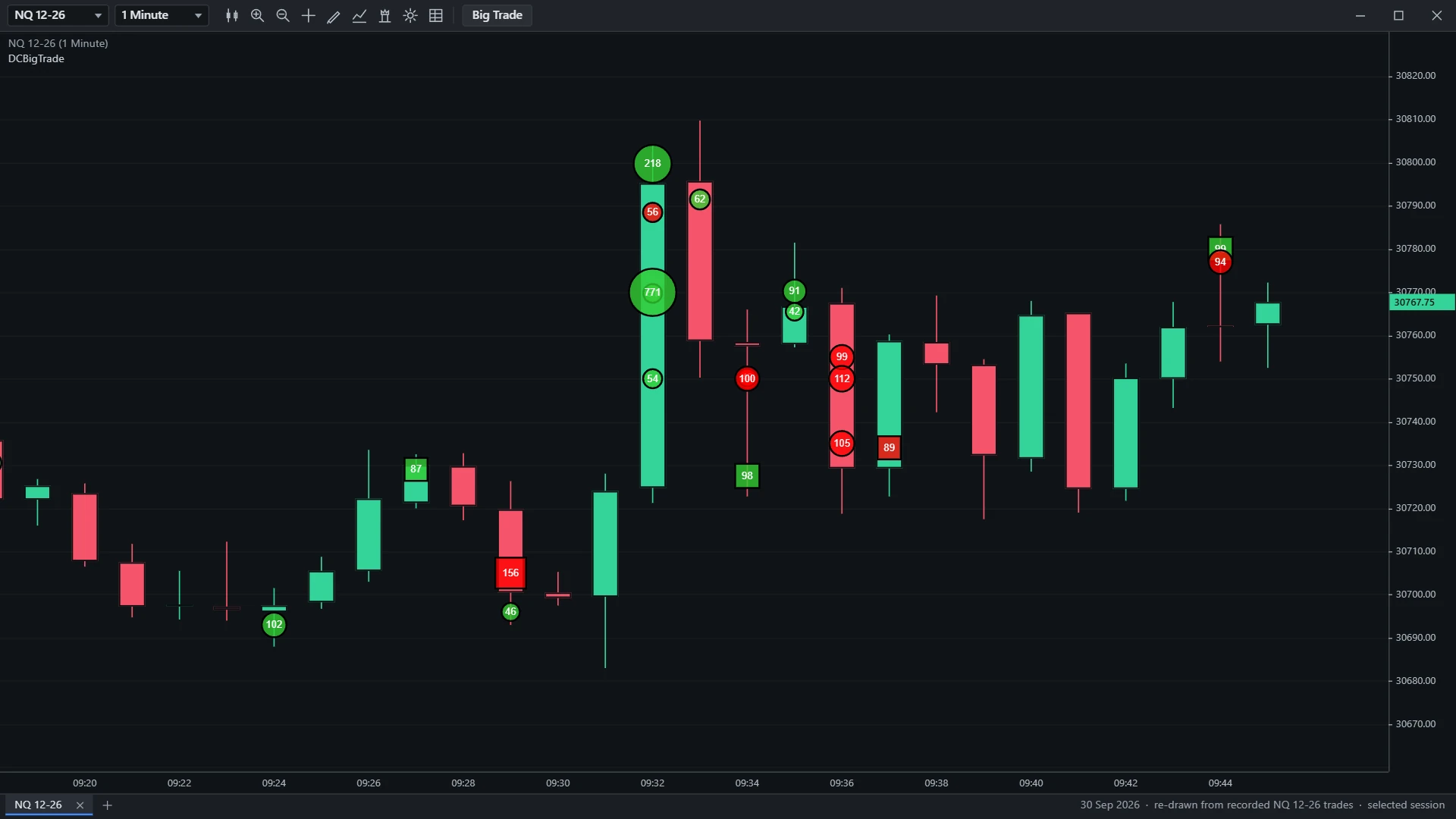
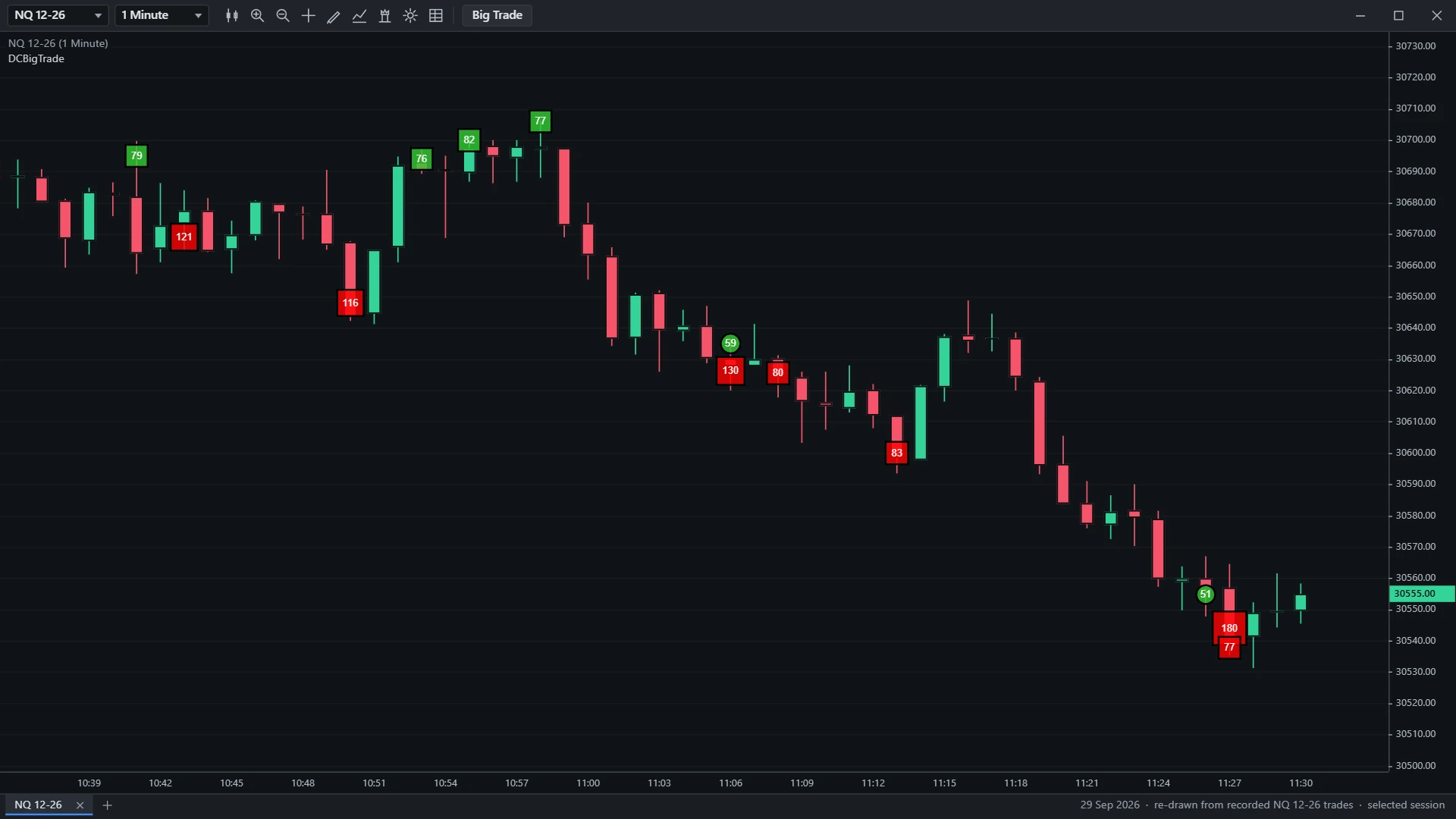
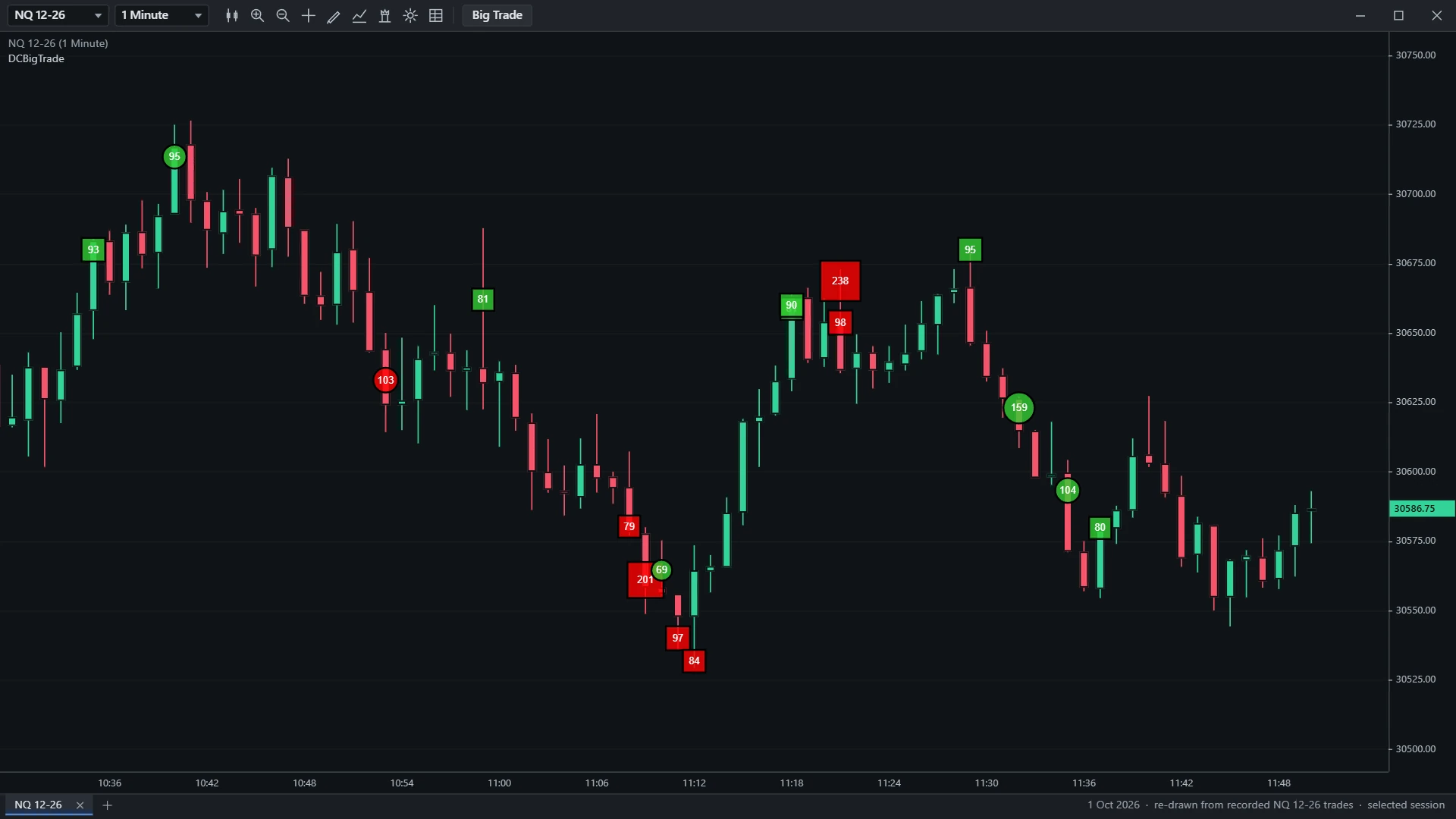
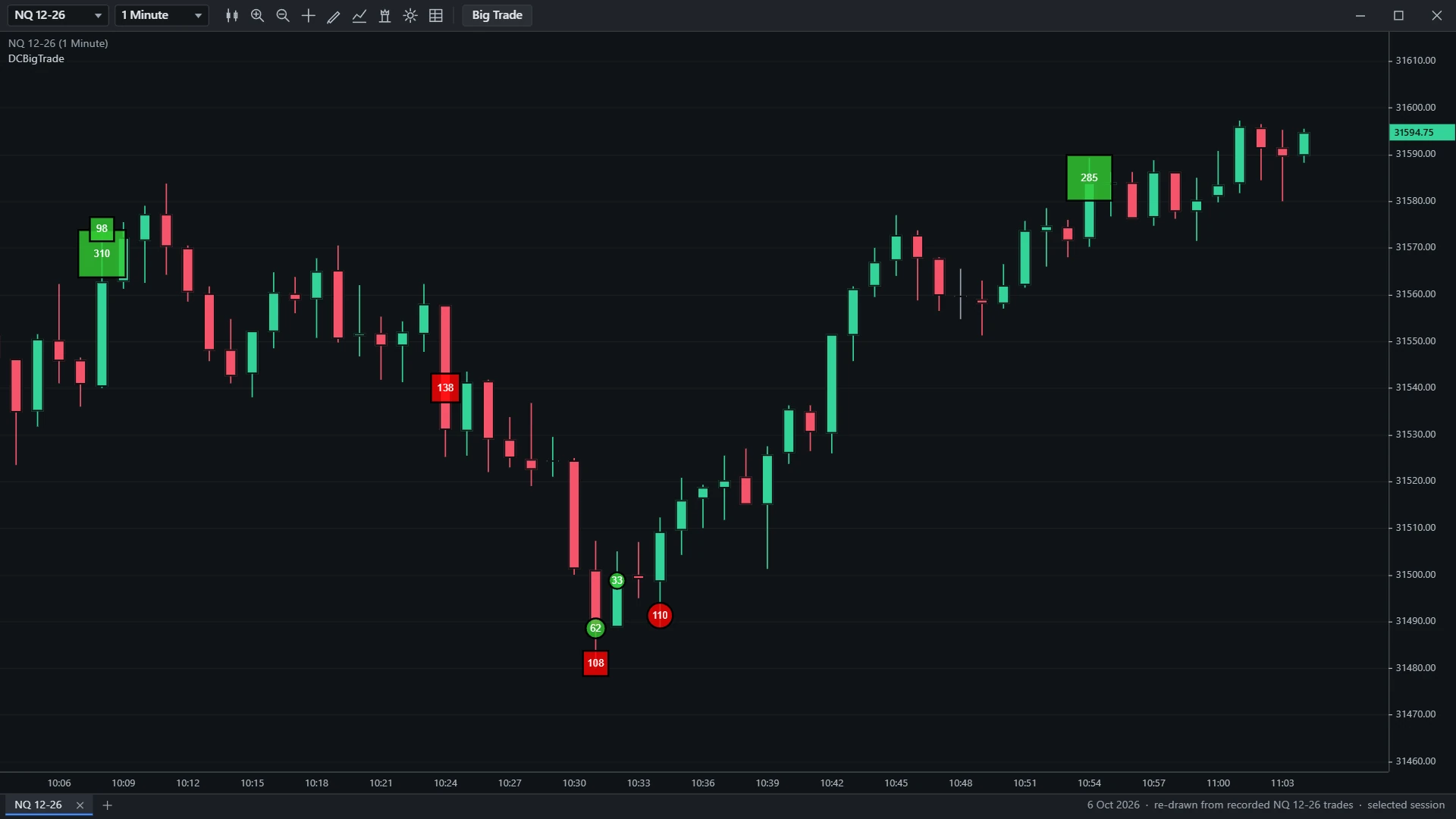
Re-drawn from recorded NQ 12-26 trades on selected sessions — illustrations, not trading results.
Two different events, two different shapes
Block — a circle
A cluster holding one large print, 30 contracts or more by default, however many prices it took. Traders often read it as size resting at a price. Typical on ES, where the book is deep enough that a large participant can fill significant size at a single price.
Sweep — a square
Large volume ripped across many price levels within milliseconds. Traders often read it as aggression: size taking price after price to get filled. Typical on NQ, where the book is thin enough that the same participant has to eat five or more levels.
Traders often read them as opposites: one a wall, the other a battering ram. Drawing them with the same marker would be throwing away the only piece of information that matters.
Why one filter is not enough
This is the measurement that produced the design, and it is the reason the indicator has two tests instead of one setting.
On a real log of roughly 31,000 clusters across ES, NQ and RTY, a filter that looks only at individual print size misses 30 to 50% of the largest market events.
The reason is structural rather than statistical. ES has a deep book, so a large participant fills big size at one price and the print itself is large — blocks are common. NQ has a thin book, so the same participant has to eat five or more levels and no single print is remarkable — sweeps are common.
Set a size threshold high enough to be meaningful on ES and you may see almost nothing on NQ. Set it low enough for NQ and ES becomes unreadable. There is no single number that works on both, which is why there are two tests with separate thresholds.
Reading the marks
Shape
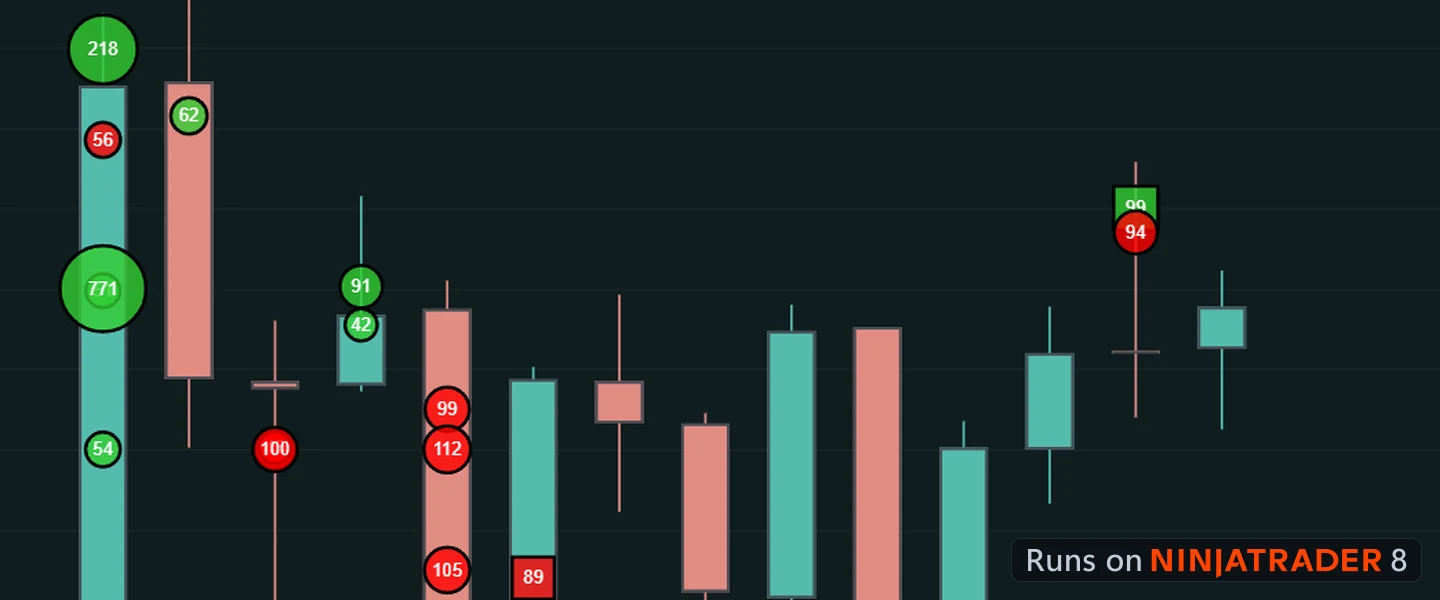
Circle for a block, square for a sweep.
Number
Total contracts in that event, written inside the shape.
Colour
The aggressor. Green if the buyer lifted the ask, red if the seller hit the bid.
Position
At the price where most of the event’s contracts traded, on the bar where it began — not at the bar’s close.
The combination is what carries meaning. A large red sweep into a level and a large red block sitting at the same price are different events, and traders read them differently. The marks show which one happened; the reading stays yours.
Thresholds that know what time it is
What counts as “big” at 03:00 is not what counts as big at 09:30. Optional session thresholds, off by default and preset for ES, cover 09:00–16:30 and 16:30–23:00 chart time; set them from the panel the Big Trade button opens on the chart toolbar.
Why filtering happens at render time
Every cluster above a low collection threshold is stored unfiltered. The block, sweep and session filters are applied when the chart draws.
That means you can change a threshold and watch marks appear and disappear instantly on historical bars. When you settle on your numbers, copy them into the indicator’s properties to keep them with the chart. Calibration takes minutes rather than an afternoon — and calibration is the whole game with this kind of tool.
Starting thresholds
| NQ | ES | RTY | |
|---|---|---|---|
| Block minimum size | 30 | 60 | 25 |
| Sweep minimum total | 75 | 150 | 60 |
| Sweep levels | 5+ | 3+ | 3+ |
Start here, then use the live panel: raise the threshold until only the events that visibly mattered are still marked.
Key facts
| Platform | NinjaTrader 8, Windows |
|---|---|
| Order Flow+ required | No — it reads the trade stream itself |
| Tick Replay | Required for historical marks. Real time works without it, from the moment you load the indicator. |
| Detection | One clustering pass, two tests — block (largest print) and sweep (volume across prices) |
| Timeframes | Any. Detection happens at tick level; marks are placed on whatever bars you draw. |
| Tuning | Live panel from the chart toolbar, optional session thresholds |
| Price | $249 one-time, lifetime updates, 3 machines |
The per-candle POC line is a separate indicator — DC POC Candle, free.
Separate product, or the layer inside the footprint?
Both exist, deliberately, and the difference is worth stating plainly rather than leaving you to work out.
| DC Big Trade | Inside DC OrderFlow Chart | |
|---|---|---|
| Runs on | Any chart, plain candles included | The footprint chart |
| Session thresholds | Optional, off by default | Single threshold set |
| Live tuning panel | Yes, from the chart toolbar | Yes, from the Order Flow button in the chart toolbar |
| Made for | Seeing size without a footprint on the chart | Already running the footprint |
The footprint layer measures size at one price; DC Big Trade also marks size spread across many prices. If you want to see where size traded on a clean candle chart, this is the one.
DC Big Trade — $249
One payment, licensed for life, updates included — three machines, per person. Delivered the moment you pay: a portal account and a licence key. Stripe is the seller of record and the price shown is the total. Fourteen days to change your mind, no reason needed — you are not asked to waive that right.
Frequently asked questions
How is a sweep different from just a big bar?
A big bar is a lot of volume over a whole bar’s duration. A sweep is a lot of volume across many prices inside a window of milliseconds. One is a bar’s total; the other is one same-side burst within 50 ms.
How do I set it up for ES and NQ?
Save a template per instrument. ES has a deep book and NQ a thin one, so each gets its own thresholds; starting numbers are in the table above.
Does it work on any timeframe?
Yes. Detection happens at tick level, and the marks are placed on whatever bars you are drawing.
How do I see marks on older bars?
Switch on Tick Replay, and historical prints are replayed from the tick stream. In real time the indicator works from the moment it loads.
Can I buy it today?
Yes. Checkout is open and delivery is immediate — a portal account and a licence key the moment you pay, good for three machines. Stripe is the seller of record, the price shown includes any VAT due, and you have 14 days to change your mind, no reason needed.
Lock the founder price
All ten indicators, the copier and the Telegram agent, lifetime: $922.50 for the first thirteen founders, then $1,845 up to fifty. Your licence and portal account are created with the email address you pay with.